AI Citation Gap Analysis Workflow
A practical workflow for finding where competitors are cited in AI answers, where a brand is missing, and what content to refresh first.
When AI systems cite competitors instead of you, what should you fix first?
Purpose
This workflow turns AI search results into an actionable content and authority plan. It helps teams compare prompt coverage, citation patterns, competitor visibility, and owned content readiness so they can decide what to refresh, what to create, and what to measure next.
Workflow
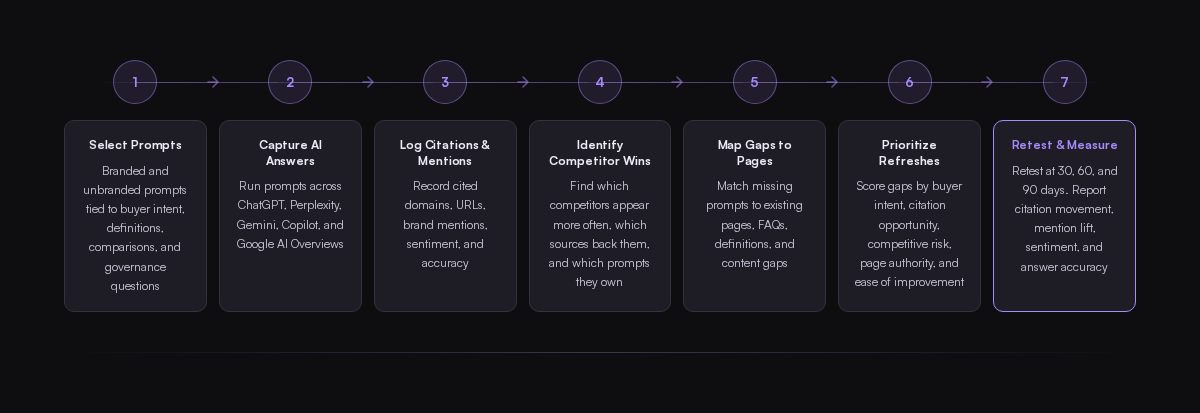
| Step | What it does |
|---|---|
| 1. Select prompts | Choose branded and unbranded prompts tied to buyer intent, definitions, risks, comparisons, tools, and governance questions. |
| 2. Capture AI answers | Review answers across ChatGPT, Perplexity, Gemini, Copilot, and Google AI Overviews. |
| 3. Log citations & mentions | Record cited domains, cited URLs, brand mentions, answer position, sentiment, and description accuracy. |
| 4. Identify competitor wins | Find which competitors appear more often, which sources support them, and which prompts they own. |
| 5. Map gaps to pages | Match missing prompts to existing pages, FAQs, definitions, comparison sections, proof points, and content gaps. |
| 6. Prioritize refreshes | Score each gap by buyer intent, citation opportunity, competitive risk, page authority, and ease of improvement. |
| 7. Retest and measure movement | Retest at 30, 60, and 90 days to measure directional lift in mentions, citations, source inclusion, and answer accuracy. |
Bottom line: Find where AI systems trust competitors more than your brand, then turn that gap into a targeted refresh and retest plan.
When to Use This Workflow
- A competitor is repeatedly cited in AI answers where your brand is absent.
- A brand appears in traditional rankings but is missing from AI-generated answers.
- AI systems cite outdated, weak, or third-party sources instead of owned pages.
- A team needs to decide whether to refresh existing content or create new pages.
- Leadership wants a measurable AEO/GEO plan beyond general visibility claims.
Inputs Needed
| Input | Purpose | Example |
|---|---|---|
| Prompt set | Defines what AI answer behavior will be tested. | 15 to 30 buyer-style prompts. |
| Target brand | Sets the brand being measured. | The company, product, or service being audited. |
| Competitor list | Identifies brands to compare against. | 3 to 8 direct or category competitors. |
| Owned URL list | Connects prompt gaps to existing assets. | Priority pages, blogs, guides, resources, and templates. |
| AI platforms | Shows where prompts will be tested. | ChatGPT, Perplexity, Gemini, Copilot, and AI Overviews. |
| Tracking sheet | Standardizes evidence capture. | Prompt, platform, cited URL, brand mention, sentiment, and next action. |
Step-by-Step Workflow
Choose prompts that reflect how buyers, researchers, and evaluators ask questions in AI search. Include definition, problem, comparison, governance, and tool-selection prompts. Start with 10 to 15 prompts for a lightweight audit, then expand as needed.
Run each prompt across selected AI platforms. Record the platform, date, prompt, answer summary, cited URLs, cited domains, brand mentions, and competitor mentions. Save screenshots when evidence is needed for reporting.
Classify each citation by source type, such as documentation, media, vendor page, forum, video, research, or education source. Flag repeated sources that appear across multiple prompts. Identify trusted non-vendor sources that shape the category.
Track target brand mentions separately from domain citations. Record competitor mentions by prompt and platform. Tag sentiment as positive, neutral, mixed, or inaccurate.
Match each prompt to the closest existing page. Check whether that page answers the prompt directly. Identify missing definitions, FAQs, comparison sections, proof points, and schema opportunities. Prioritize pages that already have authority, internal links, or relevant traffic.
Refresh first when an existing page can answer the prompt with improvements. Create new content only when no current page fits the intent. Use buyer intent, competitor presence, content readiness, authority potential, and measurement value to rank actions.
Retest the same prompts at 30 days. Review again at 60 and 90 days. Report citation movement, mention movement, sentiment, description accuracy, and cited URLs.
Example Citation Gap Output
Use this table to translate AI search visibility gaps into content actions. This example is illustrative and based on AI data security prompt testing, citation review, and competitor visibility patterns.
Below is an illustrative output showing how prompt-level evidence becomes a specific content action.
| Prompt | AI Engine | Competitors or Sources Cited | Brand Cited? | Gap Identified | Recommended Action | Priority |
|---|---|---|---|---|---|---|
| What are the best tools for securing enterprise AI applications? | ChatGPT | Microsoft, IBM, Palo Alto Networks | No | No answer-first comparison content and no strong tool evaluation page | Create or refresh a comparison page with answer-first summary, evaluation criteria, FAQ, schema, and proof points | High |
| How can companies prevent sensitive data exposure in ChatGPT and Microsoft Copilot? | Perplexity | Microsoft, TechTarget, Proofpoint | No | Brand absent from Copilot-related guidance content | Refresh existing AI security page with a Copilot section, concise risk summary, FAQ module, and cited proof | High |
| What is AI data security? | Gemini | IBM, Snowflake, Cyberhaven | No | Weak definition-level content and low citation eligibility | Add a definition-led page intro, supporting FAQ, schema, and concise use-case examples | Medium |
| How should enterprises govern data access for AI agents? | Copilot | Microsoft, AWS, Palo Alto Networks | No | No page directly aligned to AI agent governance intent | Create a focused page on AI agent governance, permissions, sensitive data exposure, and access controls | High |
Prioritization Scorecard
Score each opportunity from 1 to 5, then prioritize the highest total scores first.
| Factor | Question | Score | Notes |
|---|---|---|---|
| Buyer intent | Does the prompt reflect a real evaluation or purchase journey? | 1 to 5 | |
| Competitor presence | Are competitors cited or mentioned where the brand is absent? | 1 to 5 | |
| Content readiness | Is there an existing page that can be refreshed quickly? | 1 to 5 | |
| Authority potential | Can the brand support the page with proof, sources, and internal links? | 1 to 5 | |
| Measurement value | Will the prompt be useful to retest over time? | 1 to 5 |
Measurement Plan
Recommended Tools
| Tool Type | Examples | Use Case |
|---|---|---|
| AI visibility monitoring | Profound AI, Peec AI, Scrunch AI, Otterly.ai, or manual testing | Track prompts, citations, and brand mentions. |
| Manual LLM testing | ChatGPT, Perplexity, Gemini, Copilot | Validate answer quality and citation behavior. |
| SEO data | Google Search Console, Semrush, Ahrefs | Prioritize pages and query opportunities. |
| Analytics | GA4, Looker Studio | Track referral behavior and conversion signals. |
| Crawl and technical review | Screaming Frog, Sitebulb | Identify page structure, metadata, schema, and crawl issues. |
| Tracking system | Google Sheets, Airtable, Notion | Maintain prompt logs, evidence, and action status. |
30-Day Execution Plan
| Timeline | Action | Output |
|---|---|---|
| Days 1 to 3 | Finalize prompt set and competitor list. | Prompt set, competitor set, and tracking sheet. |
| Days 4 to 7 | Capture AI answers and citation evidence. | Baseline citation and mention report. |
| Days 8 to 12 | Classify sources and identify prompt gaps. | Gap matrix and source type summary. |
| Days 13 to 18 | Map gaps to existing pages. | Prompt-to-page map and refresh priority list. |
| Days 19 to 24 | Refresh priority pages or create briefs. | Updated page recommendations and AEO/GEO briefs. |
| Days 25 to 30 | Retest priority prompts and summarize movement. | Early signal report and next-step roadmap. |
Common Mistakes to Avoid
- Treating one AI answer as a final truth instead of looking for patterns across prompts and platforms.
- Measuring citations without separating domain citations from brand mentions.
- Creating new content before checking whether an existing page can be refreshed.
- Ignoring community, forum, video, and third-party sources that may influence AI answers.
- Promising fixed citation gains instead of measuring directional improvement and answer accuracy.
- Using generic prompts that do not reflect real buyer language.
Final Takeaway
The core AEO/GEO question is not only, "Are we ranking?" It is, "When AI systems answer buyer questions, are we part of the answer, are we cited accurately, and do we know what to improve next?" This workflow is designed to answer that question with evidence and turn the evidence into action.
About the Author
Ellen Tuckett is an AI search strategist with experience across enterprise SaaS, technology, education, and multi-location businesses. Her work combines SEO, AEO, GEO, technical SEO, structured data, entity strategy, content strategy, analytics, and AI visibility testing across platforms including ChatGPT, Gemini, Copilot, Perplexity, and AI Overviews.
Recent work includes building AI visibility measurement frameworks, tracking AI share of voice, improving citation inclusion through answer-first content, and aligning SEO and GEO strategy with enterprise buyer research behavior. ellentuckett.com
See how these principles apply in practice: AI Data Security Visibility Audit in the Proof Lab.
Looking to build answer-first content optimized for AI search visibility? See the AEO/GEO Content Brief Template in the Proof Lab.